
Stick Curling – Rules, Delivery, and How It Works
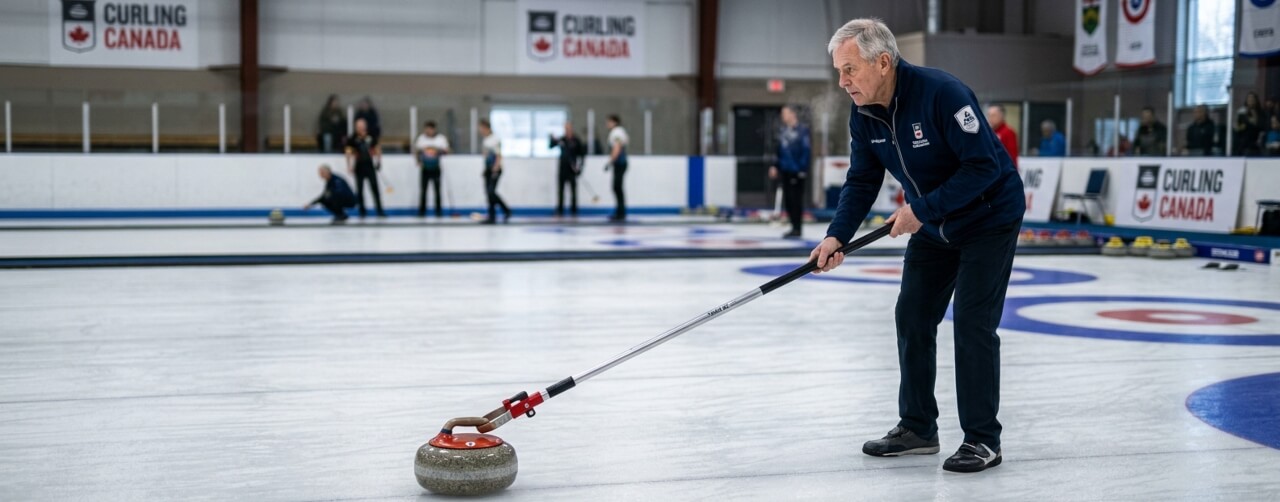
Stick curling is a version of curling where players use a delivery stick – a pole with a special head that grips the stone handle – instead of the traditional sliding delivery from the hack. The stick lets you push the stone down the ice from a standing or walking position, which removes the deep lunge and balance demands of a standard delivery.
The format was invented in Canada in 1999, originally for older curlers who could no longer get down into the hack safely. It has since grown into its own competitive category with national championships, dedicated leagues, and a governing body – the Canadian Stick Curling Association (CSCA).
Quick numbers A regulation curling stone weighs between 38 and 44 lbs (17.2-19.96 kg). The curling sheet dimensions are 150 feet long by approximately 15 feet wide. Whether you deliver with a stick or a traditional slide, you are sending that same 44-pound piece of granite down the same 150-foot sheet. The physics are the same – only the delivery method changes.
Stick Curling Rules – The Basics
The rules for curling with stick follow the same framework as traditional curling, with a few specific additions:
Rule | What It Means |
|---|---|
Stick for the full game | If you start a game using a delivery stick, you must use it for every stone in that game. No switching between stick and slide mid-game. |
Release before the hog line | Same as traditional curling – the stone must leave the stick before it crosses the near hog line. |
Hack or no hack | You can deliver from the hack (walking), from behind the hack, or from a stationary position between the house and the hog line. |
Centre line rule | If delivering from a stationary position, the stone must be within 18 inches of the centre line, and you cannot stride forward. |
Double grippers required | Both shoes must have rubber grippers. Using a slider with a delivery stick is considered unsafe. |
Not allowed in championships | Curling Canada does not permit delivery sticks in events leading to national championships (except wheelchair curling). Stick curling has its own championship track through the CSCA. |
The full stick curling rules are maintained by the CSCA and updated regularly. The most recent revision was in July 2025. Curling Canada also includes an abbreviated version in their Rules for General Play under Rule 19.
Three Ways to Deliver with a Stick
The CSCA rules define three legal delivery positions:
- From the hack (walking delivery) – The most common method. You place one foot in the hack, then walk forward toward the skip’s broom while pushing the stone with the stick. The stone is released before the hog line. Most players take an odd number of steps – 5, 7, or 9 – so the opposite foot is forward at release.
- From behind the hack – Same walking motion, but you start a step or two behind the hack. Some players find this gives a more natural walking rhythm.
- Stationary delivery – The stone is placed between the top of the house and the near hog line, within 18 inches of the centre line. The player pushes the stone forward without stepping. Used by players with limited mobility, including wheelchair curlers.
How the stick works A delivery stick is a lightweight pole (usually aluminum, adjustable from about 1 to 1.75 metres) with a gooseneck head that clips onto the stone handle. You set the handle to 10 o’clock or 2 o’clock, walk forward, and rotate the stick to 12 o’clock on release – this gives the stone its curl. Pulling the stick back detaches it from the handle cleanly.
Stick Curling vs. Traditional Curling
Aspect | Traditional | Stick |
|---|---|---|
Delivery method | Slide from hack on one foot | Walk from hack (or stationary push) |
Physical demand | Deep lunge, balance, flexibility | Walking, upright posture |
Footwear | One slider, one gripper | Double grippers (both feet) |
Sweeping (4-person) | Yes | Yes |
Sweeping (2-person stick) | n/a | No sweeping allowed |
Stone weight and rotation | Same | Same |
Strategy and scoring | Same | Same |
Championship pathway | Curling Canada / WCF events | CSCA provincial and national events |
The game itself – the strategy, the scoring, the ice, the stones – is identical. The difference is in how you get the stone moving.
Who Plays Stick Curling?
The format started as an option for older curlers, but it has expanded well beyond that:
- Curlers with knee, hip, or back issues – the traditional delivery puts heavy load on the knee and hip of the sliding leg. The stick removes that entirely.
- Older adults returning to the sport – many people curled for decades, stopped because the delivery became too hard on their body, and came back through stick curling.
- Wheelchair curlers – delivery sticks are standard equipment in wheelchair curling and have been since the sport entered the Paralympics in 2006.
- Beginners who find the slide intimidating – some clubs in Ontario now offer stick curling as a first step for people who want to try the sport.
In Ontario, Curling Ontario runs a provincial stick championship each year, and the CSCA organizes a national two-person stick championship. Stick leagues are available at a growing number of clubs across the Hamilton and district curling area.
Where was curling started? The sport traces back to 16th-century Scotland. The oldest known curling stone, found in a drained pond in Stirling, is inscribed with the date 1511. Scottish immigrants brought the game to Canada around 1760, and the Royal Montreal Curling Club – founded in 1807 – is the oldest active sports club in North America. The delivery stick, by contrast, is a modern Canadian invention from 1999. Sources: World Curling Federation, Wikipedia
Stick Curling at Bonspiels and Events
Stick curling is not just a league format – it has its own tournament circuit. A curling bonspiel is a multi-game tournament, typically running one to three days, where teams from different clubs compete. Stick bonspiels follow the same structure: round-robin or bracket play, meals, prizes, and the social side that makes bonspiels one of curling’s best traditions.
The CSCA national two-person stick championship is the top competitive event in Canada for stick curlers. At the club level, many facilities now include stick divisions in their regular bonspiels, or run dedicated stick-only events.
Equipment You Need
Item | Notes |
|---|---|
Delivery stick | Adjustable, aluminum. Ideal length is ground to chin. Some clubs have loaners. New sticks cost $50-$150. |
Shoes with double grippers | Both soles must be rubber. No sliders. Clean soles required. |
Warm, stretchy clothing | Layers that allow a full walking stride. Avoid jeans for your first time. |
Gloves (optional) | Light athletic gloves help with grip in cold conditions. |
Helmet (recommended) | Curling Canada recommends head protection for stick curlers, especially new players. |
Most clubs that offer stick curling have loaner sticks available, so you can try the format before buying your own equipment.
How to Try Stick Curling in the Dundas-Hamilton Area
If you are interested in trying stick curling, the best starting point is your nearest curling club. Many clubs in the Hamilton and district curling area allow stick delivery in their recreational leagues, and some run dedicated stick curling sessions or leagues.
Open houses at the start of each curling season (September-October) are a good time to ask about stick options.
For general information about curling clubs, leagues, and granite club membership costs in this area, see the main page at dgcc.ca.
This is an independent educational resource, not affiliated with any previous website operators.