
How Curling Works – Ends, Scoring, Positions & Key Terms
If you have ever watched curling on TV and thought “I have no idea what is going on” – you are not alone. The yelling, the sweeping, the stones sliding into a bullseye – it looks confusing from the outside. But the actual game is not that complicated once someone breaks it down for you.
This page covers how curling works from the ground up: the structure of a game, how to score, what each player on the team does, and the curling terms you will hear at any club or on any broadcast. If you are completely new to the sport, this is curling for beginners in plain language.
The Basic Idea
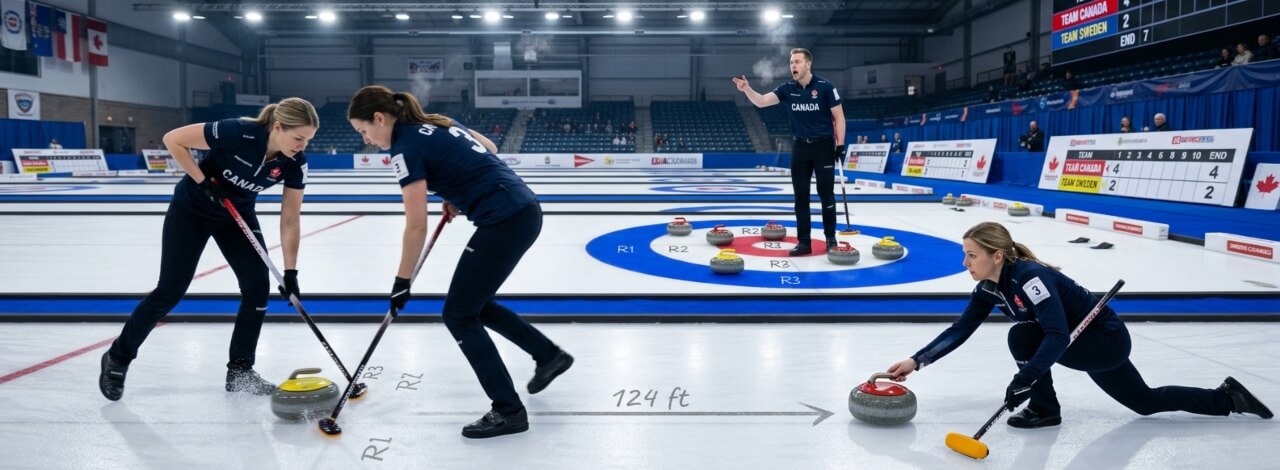
Two teams of four players take turns sliding granite stones down a long, narrow sheet of ice toward a circular target called the house. The goal is to get your stones closer to the centre of the house than your opponent’s stones. Closer stones score points. That is the whole game at its core.
Each stone weighs between 38 and 44 pounds. The ice is not smooth like a hockey rink – it is covered in tiny frozen water droplets called “pebble,” which is what makes the stones curve (or “curl”) as they slow down. That curve is where the sport gets its name.
Where was curling started? Scotland, in the 1500s. The oldest known curling stone was found in a drained pond near Stirling and is dated 1511. Scottish immigrants brought the game to Canada around 1760. The Royal Montreal Curling Club, founded in 1807, is the oldest active sports club in North America. Source: World Curling Federation
How Many Ends in Curling?
A curling game is divided into rounds called “ends.” Think of an end like an inning in baseball. Each end is one complete round where both teams throw all their stones.
In each end, every player on both teams throws two stones, alternating with the other team. That is 8 stones per team, 16 stones total per end. After all 16 stones have been thrown, the score for that end is counted, the ice is cleared, and the next end starts – going the other direction.
Format | Number of Ends |
|---|---|
International and Olympic play | 10 ends |
Most club and recreational leagues | 8 ends |
Mixed doubles (Olympic format) | 8 ends |
Some social or timed leagues | 6 ends |
If the score is tied after the last end, extra ends are played until one team scores. A full 8-end game takes roughly two hours at the club level.
Blank ends If no stones from either team are touching the house at the end of an end, nobody scores. This is called a “blank end.” Sometimes teams blank an end on purpose – the team that does not score keeps the last-stone advantage (the “hammer”) for the next end, which is a real strategic benefit.
Once you understand how ends and the hammer work, the game becomes much easier to follow in real situations.
What to Do After You Understand Curling Basics
Now that you understand how ends, scoring, and the hammer work, curling starts to make much more sense on TV. What once looked confusing becomes easier to follow, and you can begin to recognize strategy in real time. The natural next step for most beginners is simply to watch more games. International tournaments, national championships, and club-level matches all follow the same structure you just learned. As you watch, you will start noticing patterns – when teams play aggressively, when they blank an end, and how they use the hammer to control the game.
Some fans take this a step further and begin making their own predictions about how an end will play out. Because curling is highly strategic, even basic knowledge can help you anticipate decisions and outcomes. There are also online platforms where viewers engage with sports in a more interactive way, including match tracking, predictions, and other entertainment formats. As with any form of online entertainment, it is important to approach these options responsibly and focus on the enjoyment of the game itself.
How to Score in Curling
Scoring happens after each end, once all 16 stones have been thrown. Only one team can score in any given end – the team with the stone closest to the centre of the house (the “button”). That team gets one point for each of their stones that is closer to the button than the other team’s closest stone.
- Only stones in the house count. A stone has to be touching the house (the coloured circles) or hanging over the edge to be eligible for scoring.
- Scoring 1 point with the hammer is considered a bad end. The team throwing last has a built-in advantage, so scoring just 1 with it is a missed opportunity. A good hammer end scores 2 or more.
- Stealing is a big deal. If the team without the hammer scores, that is called a “steal.” Steals shift momentum and are one of the biggest swings in the game.
- The highest possible score in one end is 8 – one point for each stone. This almost never happens. It is called an “eight-ender” and is the curling equivalent of a hole-in-one.
Curling Positions Explained
A curling team has four players. Each one throws two stones per end, in a fixed order, and has a specific role on the team:
Position | Throws | Main Role |
|---|---|---|
Lead | Stones 1 & 2 | Sets up the end with guards and draws. Sweeps the next six stones. Needs to be a strong, consistent sweeper. |
Second | Stones 3 & 4 | Bridges setup and attack. Plays a mix of draws and takeouts. Sweeps during lead’s throws and the final four stones. |
Third (Vice) | Stones 5 & 6 | Plays all shot types. Stands in the house to help the skip read the play. Takes over as acting skip when the skip is throwing. |
Skip (Fourth) | Stones 7 & 8 | Team captain. Calls all shots, tells each player where to aim and when to sweep. Throws last – the highest-pressure stones. |
The skip is not required to throw last – the rules allow any player to throw from any position – but in almost every team at every level, the skip throws the final two stones.
Types of Shots
- Draw – A shot thrown to come to rest inside the house, in a scoring position. A “freeze” is a draw that stops right against an opponent’s stone.
- Guard – A stone placed in front of the house (in the “free guard zone”) to protect stones behind it. Guards are usually thrown early in the end by the lead.
- Takeout – A hard shot meant to knock an opponent’s stone out of play. Variations include “hit and roll” and “double takeout” (remove two stones with one shot).
The free guard zone rule prevents either team from removing the other team’s guards during the first five stones of an end. This rule was added in 1991 because teams kept clearing everything off the ice, leading to low-scoring, repetitive games.
Sweeping
When you sweep the ice in front of a moving stone, you warm the pebble slightly. This reduces friction, which makes the stone travel farther and curl less. Two teammates sweep at the same time, using brooms with a fabric pad on the bottom.
The skip decides whether sweeping is needed by watching the stone’s speed and line, then calling out instructions – “hard!” (sweep as fast as you can), “off!” (stop sweeping), or “clean!” (light sweeping just to clear debris).
Past the tee line, only one player from each team can sweep. This is where the opponent can also sweep your stone – a rare situation that usually only happens when a stone is heading toward the back of the house.
Why “hurry hard”? This is the call you hear most often during a curling broadcast. “Hurry” tells the sweepers to start, and “hard” means maximum effort. Sweepers can cover about 1.5 kilometres of sweeping in a single game – it is a genuine workout.
Curling Etiquette
Curling has a code of conduct that is baked into the sport, and it goes well beyond normal sportsmanship. The World Curling Federation calls it the Spirit of Curling, and it is written right into the first rule of the game.
- Shake hands before and after every game. You greet your opponents with “good curling” at the start and thank them at the end, regardless of the result.
- Call your own fouls. If you touch a stone with your broom or foot while it is in play (“burning” a stone), you are expected to say so – even if nobody else saw it. There are no referees in most club play. The game runs on honesty.
- Do not cheer mistakes. You do not celebrate when your opponent misses a shot. Taunting or trash-talking is not part of the culture.
- Winners buy the first round. After the game, both teams sit together in the lounge. The winning team traditionally buys the losing team a drink. This is one of curling’s oldest social traditions.
- Be ready when it is your turn. Do not slow down the game. Have your shoes clean, know what shot the skip is calling, and be in position.
“Curlers play to win, but never to humble their opponents. A true curler would prefer to lose rather than win unfairly.”
– The Spirit of Curling, World Curling Federation Rules of Curling
Curling Terms You Should Know
Curling has its own language. Here are the terms you will hear at any club or on any TV broadcast:
Term | What It Means |
|---|---|
House | The circular target area – four concentric rings (12-foot, 8-foot, 4-foot, and the button). |
Button | The very centre of the house. Getting a stone on the button is the ideal draw shot. |
End | One round of play. Both teams throw all 8 stones, then the score is counted. |
Hammer | Last-stone advantage. The team that did not score in the previous end gets the hammer. |
Bonspiel | A curling tournament – a multi-game event, usually one to three days, where teams from different clubs compete. |
Hack | The rubber foothold at the end of the sheet that players push off from when delivering a stone. |
Hog line | The stone must cross this line to stay in play. The player must release before the near hog line. |
Pebble | Frozen water droplets sprayed onto the ice surface. The pebble gives curling ice its texture and makes stones curl. |
Weight | The speed or force behind a shot. “Draw weight” reaches the house. “Takeout weight” knocks stones out. |
Burning a stone | Accidentally touching a moving stone. You are expected to call this on yourself. |
Blank end | An end where no stones are in the house, so nobody scores. Can be deliberate to keep the hammer. |
Steal | When the team without the hammer scores. A steal flips the game’s momentum. |
Free guard zone | Area between hog line and house. Guards here cannot be removed during the first five stones of an end. |
Skip | Team captain. Calls strategy, holds the broom as target, throws the last two stones. |
Hurry hard | The most common sweeping call. “Hurry” = start sweeping. “Hard” = maximum effort. |
Where to Go from Here
Now that you know how curling works, the next step is to try it. Most curling clubs offer free open houses at the start of each season (September-October in Ontario) where you can throw stones, try sweeping, and see whether the sport is for you.
If you are in the Dundas-Hamilton area, see dgcc.ca for information on local clubs, league types, and membership costs. If you are interested in formats that do not require the traditional sliding delivery, check out the stick curling page.
This is an independent educational resource, not affiliated with any previous website operators.